Accepted Sessions
All conference sessions, including invited/organized (curated) symposia, are open for attendance by all registered conference delegates.
Brief Session Definitions:
Workshops (1.5 – 8 Hours) : Interactive sessions designed for professional development or technical training.
Short Courses (2 – 8 Hours) : Training sessions in specific topics of key relevance to marine conservation.
Focus Groups (1.5 – 8 Hours) : Discussion-based sessions aimed at creating tangible outputs, such as policy briefs, white papers, or publications.
Symposia (90 Minutes) : Thematically focused sessions featuring multiple speakers presenting research on a specific conservation issue.
Organized / Invited (Curated) Symposia: Facilitators develop the session topic and invite all presenters. These sessions are open to all registered conference delegates.
Open Symposia: Facilitators set the topic, and any delegate may submit an abstract to present.
Symposia + Focus Groups (3 Hours) : A combined format for organizers wishing to follow a formal presentation session with a related, in-depth discussion group.
Panel Discussions (90 Minutes) : Interdisciplinary sessions designed to foster dialogue on emerging research, policy, or community-led initiatives.
Art-Led Conservation Engagement : Interactive, visual, or performance-based projects that bridge science and art to inspire ocean action.
Please find the list of accepted IMCC8 sessions, detailed descriptions and speaker/organizer info below:
-
Accepted IMCC8 Symposia and Panel Discussions (including speakers)
-
Accepted IMCC8 Workshops, Short-Courses, and Focus Groups (including organiser info)
- See a quick overview of accepted Symposia, Panel Discussions, Focus Groups, Workshops, and Art-led Sessions.
Symposia
Open Symposia :
-
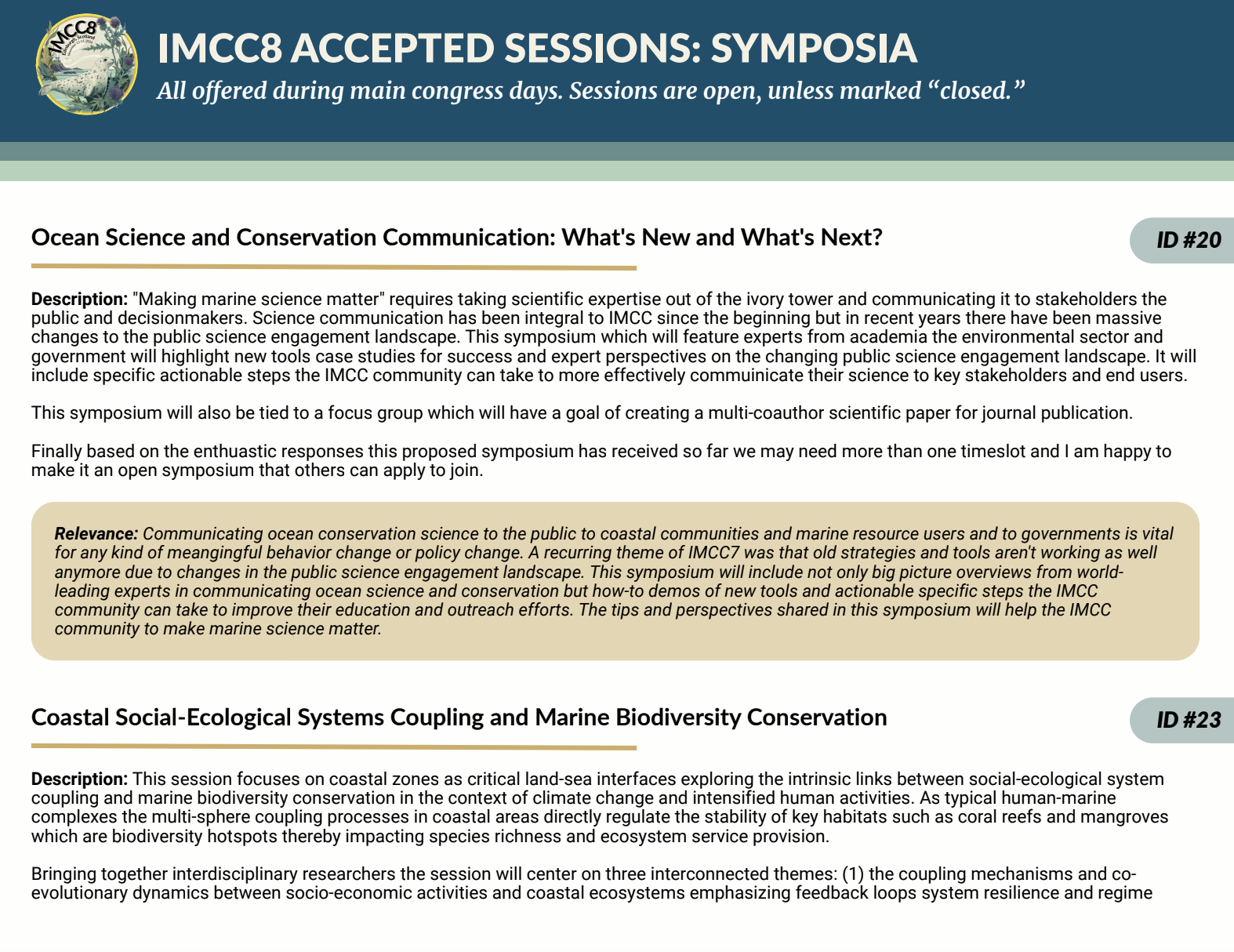
Coastal Social-Ecological Systems Coupling and Marine Biodiversity Conservation: This symposium explores the links between human activities and coastal ecosystems, focusing on system resilience and Nature-based Solutions. It aims to foster synergies between socio-economic development and biodiversity conservation to support global "30x30" targets.
-
Ocean Science and Conservation Communication- What's New and What's Next?: This session features experts from multiple sectors sharing new tolls and actionable steps to improve how marine science is communicated to stakeholders and the public. It also includes a focus group aimed at producing a multi-co-authored scientific paper.
-
Towards Sustainable Aquafeed: Should We Use Fish to Feed Fish?: Researchers will discuss the ethical and environmental concerns of harvesting wild fish to produce aquafeed for the expanding aquaculture industry. The goal is to identify points of disagreement and propose solutions to reduce pressure on wild fish stocks.
-
Cumulative and Synergetic Stressors to Marine Megafauna: This session focuses on how interactive anthropogenic stressors, such as pollution and climate change, cumulatively affect turtles, sharks, and marine mammals. It aims to advance holistic assessments to better inform management strategies in human-impacted oceans.
-
Evaluation and Assessment for Marine Protected Areas: This session reviews established and new evaluation tools for Marine Protected Areas (MPAs) to foster adaptive learning and improve management quality. It brings together practitioners and academics to consolidate lessons learned from diverse global settings.
-
Human Dimensions of Large-Scale Marine Protected Areas: Lessons for BBNJ Implementation: Focusing on Large-Scale Marine Protected Areas (LSMPAs), this session applies social-process insights to the implementation of the new BBNJ Agreement. It aims to identify design principles and research gaps to ensure durable ABNJ conservation outcomes.
-
UK MPAs: success stories in science stakeholders and governance over 17 years of change: What have we learned?: This group reflects on 16 years of UK MPA management, reviewing interdisciplinary best practices and regional management discrepancies. It aims to determine future needs for monitoring and enforcement within the network.
-
The Role of Diverse Knowledge Systems and Values in Ocean Conservation: Presenters will share case studies on how cultural knowledge and traditional values can co-create solutions to pressing ocean problems. The session explores pathways for transformative change in humanity’s relationship with the ocean.
-
From Reflection to Action: Advancing Equity, Participation, and Impact in Marine Conservation: This session examines inclusive, people-centered approaches to ocean conservation, including co-design of research and Indigenous agency. It aims to catalyze a more just global conservation community by shifting toward trust-based partnerships.
-
Turning Tides: Behavior Change and Conservation Marketing Strategies: Organized by the Conservation Marketing and Engagement Working Group, this session applies behavioral science to marine challenges like vessel strike reduction and ocean literacy. It emphasizes measurable shifts in human behaviors to promote ocean health.
-
Citizen (Participatory) Science for Marine and Coastal Conservation: This seminar showcases successful marine citizen science projects to provide inspiration and guidance for current and future initiatives. It revisits toolkits and principles established in previous IMCC sessions to advance the field.
-
Ocean Equity, Fairness, and Justice (Open Session): This symposium explores procedural justice and intersectionality in marine conservation, focusing on who bears the costs and who benefits from global protection efforts. It aims to move from theoretical frameworks to practical, local implementation.
-
From By-catch to Management: Regional Elasmobranch catches in South Asia: This session addresses the threat of extinction for sharks and rays in South Asia due to poor fisheries management and intense poaching. It promotes transition toward active management strategies, including habitat closures and gear-specific mitigation.
-
Novel Approaches to Advancing Small Pelagic Fisheries Science and Management: Focusing on transboundary and data-poor regions, this session explores ecosystem-based and climate-smart management for forage fish. It aims to integrate diverse knowledge systems to support global food security and marine food webs.
-
From Detection to Enforcement: Interdisciplinary Solutions to Reduce IUU Fishing: Global experts will explore innovations like AI-based satellite monitoring and genetic tools to detect and prevent Illegal, Unreported, and Unregulated (IUU) fishing. The session integrates policy and finance to provide actionable strategies for global fisheries governance.
-
AI for Oceans: Innovations, Tools, and Strategies: Showcasing computer vision for species identification and predictive models for mapping habitats, this symposium emphasizes applied AI in marine conservation. It addresses challenges like model bias and ethical use while prioritizing user-centered tools for researchers and managers.
General Open Themed Sessions
- Blue Economy
- Climate Change and Ocean Acidification
- Endangered and Threatened Species
- Fisheries and Aquaculture
- Habitat Conservation and Restoration
- Human Dimensions of Ocean Conservation
- Local and Traditional Ecological Knowledge
- Deep-Sea Mining
- Hope: Marine Conservation Success Stories
- Marine Pollution
- Ocean Science and Conservation Technology
- OceansOnline
- Participatory Marine Conservation and Community Science
- General Marine Conservation
- How to Save our Oceans: Addressing Current Gaps and Emerging Needs to chart the future of marine conservation
- Reducing Bycatch in Global Fisheries to Protect Key Marine Species
- From Ocean to Plate: Improving Traceability and Sustainability across Global Seafood Supply Chains
- Strengthening MPA Effectiveness for Conservation Impact across taxa
Organized / Invited (Curated) Symposia
-
Building Effective and Equitable Area-Based Protections Through Knowledge Management: This session will share examples from four different geographies to highlight the role of knowledge management in organizing and prioritizing the ecological, social, economic, and legal opportunities at the forefront of area-based protections.
-
Restoring Seascapes: The session covers the principles of seascape ecology and restoration planning, emphasizing the importance of interconnected habitat mosaics like mangroves and coral reefs. It examines ecological connectivity as a critical pathway for reversing the loss of productive coastal environments.
-
Powering up Potential: Strengthening and Sharing Capacity for Ocean Stewardship: This symposium explores equitable, human-centric approaches to capacity sharing, drawing on global examples of intergenerational knowledge and locally managed areas. It aims to influence how capacity development is planned and implemented across ocean policy initiatives.
-
From Local to Global: The role of environmental leadership in ocean conservation across geoegraphies and sectors: Showcasing professionals from the Edinburgh Ocean Leaders programme, this session provides case studies on how creative leadership can accelerate positive conservation impact. It explores leadership's role in diverse contexts across Europe, Africa, and Latin America.
-
Emerging Tools for Resilient Tropical Fishing Communities: Social scientists will examine tools for supporting the resilience of small-scale tropical fishing communities where conservation and livelihoods are closely linked. The research focuses on transdisciplinary, use-inspired adaptation pathways.
-
Financing Community-Led Marine Conservation: Insights from the OCEAN Grants Programme: This session examines the architecture of the OCEAN Grants Programme, which supports locally led conservation in ODA-eligible countries. Speakers will discuss how sustainable fisheries and livelihood diversification are translated into grounded action.
-
The Baltic Sea as a Living Lab for Marine Protection: This symposium explores how the multi-nation Baltic Sea region serves as a living laboratory for transformative, eco-region-wide marine protection across its entire governance and management lifecycle. Through case studies and a facilitated discussion, speakers will share how integrated ecological and social data are used to build transboundary scientific collaborations and policy-relevant decision-making tools.
-
From Innovation to Impact: Advancing Marine Ecosystem Restoration in Asia: Featuring case studies from across Asia, this symposium highlights innovative practices in rewilding corals, seagrass, and oyster reefs. It addresses common challenges such as long-term monitoring and navigating cross-border policy frameworks.
-
The Marine OECM Guide: Advancing Effective Conservation in community-and country-led marine OECMs: Experts will share experiences identifying "Other Effective Area-Based Conservation Measures" (OECMs) in contexts like Mexico and Indonesia using a new co-created guide. The session highlights best practices for recognizing human rights and self-determination in conservation.
-
Place-Based Law and the Future of Marine Conservation: Indigenous Governance in the Great Bear Sea this session explores how Indigenous legal orders and histories structure marine decision-making and stewardship. It highlights how ancient governance systems can shape durable, community-driven protection at regional scales.
-
Centering Multiple Ways of Knowing in the Great Bear Sea MPA Network: Partners will discuss the collaboratively governed Great Bear Sea MPA Network, the first of its kind involving Indigenous and non-Indigenous governments in Canada. The session highlights how diverse knowledge systems shaped the network's design and monitoring.
-
Ocean Equity, Fairness, and Justice (Closed Session): This symposium explores procedural justice and intersectionality in marine conservation, focusing on who bears the costs and who benefits from global protection efforts. It aims to move from theoretical frameworks to practical, local implementation.
-
Protecting The Far Corners of the World: Conservation in Action Across UK Overseas Territories: This session explores the UK Blue Belt Programme’s work in managing vast, geographically isolated marine environments. Speakers will discuss surveillance technologies and the integration of local knowledge in remote, data-poor regions.
Panel Discussions
-
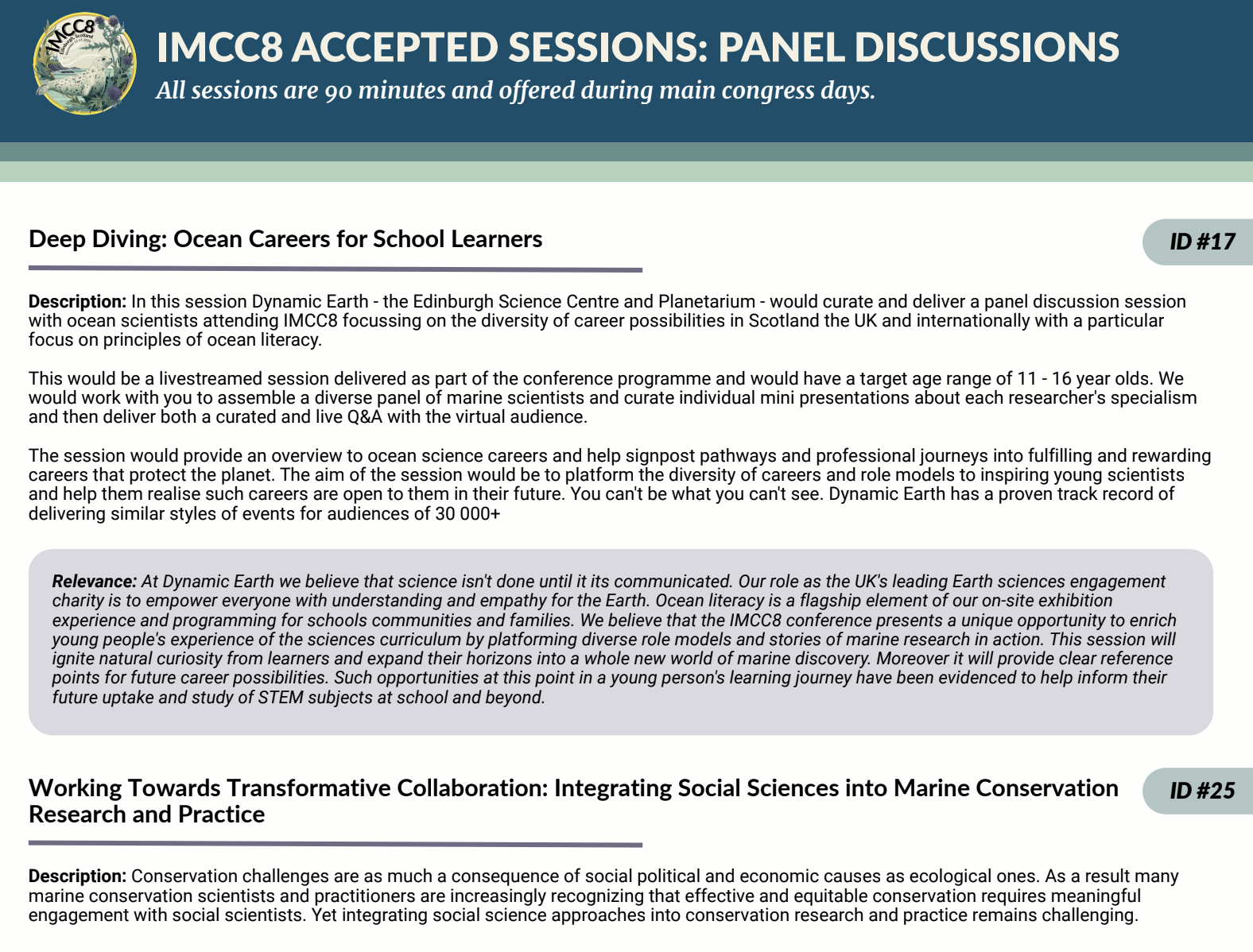
Integrating Social Sciences into Marine Conservation Research and Practice: This session brings together early-career scholars and social scientists to share practical strategies for navigating interdisciplinary collaborations. Participants will identify pathways to improve partnerships, ensuring social science frameworks are meaningfully integrated into conservation design.
-
Building Transdisciplinary Long-term Biodiversity Monitoring: Panelists will discuss the BIODIVERSITY III initiative, focusing on the need for coordinated, international long-term observations and emerging technologies like eDNA. The goal is to translate biodiversity data into integrated socio-ecological knowledge systems that support global conservation commitments.
-
Data-Driven Decisions for Marine Conservation: The Role of Transparency: This panel examines how open data, vessel tracking, and satellite monitoring can strengthen ocean governance and enforcement. Discussions will highlight practical examples where transparency supports fisheries management and the 30x30 target.
-
Pitfalls vs. Promises of 30X30: Driving Effective and Equitable Area-based Conservation: Academic scientists and Indigenous leaders will reflect on using traditional knowledge and robust data to evaluate the effectiveness of MPAs and OECMs. The panel addresses the intersection of international reporting norms and community well-being to ensure conservation outcomes are truly equitable.
-
Tools for Marine Social-Ecological Resilience: Organized by the Smithsonian Tropical Research Institute, this panel investigates how various tools—such as finance and technology—operationalize resilience in practice. The session aims to develop a "Conditions for Success" framework based on real-world experiences from researchers and community representatives.
-
From Policy to Practice: The Reality of Marine Conservation in Low-Income Countries: Researchers and policymakers will discuss structural barriers, such as limited institutional capacity and enforcement, that hinder conservation in low-income nations. The panel uses case studies to identify practical solutions for moving beyond policy documents to achieve socially sustainable outcomes.
-
Beyond Consultation: Rethinking Community Roles in Marine Conservation: This panel explores moving from simple consultation toward genuine community collaboration in the design and delivery of conservation projects. Panelists will share lessons on building trust, integrating local knowledge, and overcoming institutional constraints.
-
Learning from Our Global Community: Conversations with Small Grant Programs: Small grant funders and practitioners will reflect on lessons learned from locally led initiatives and explore what sustain projects after grant periods end. The discussion aims to inform donors and the broader community on how to best support effective, lasting conservation.
-
Curbing IUU Fishing through Monitoring, Governance, and Innovation: Global experts from organizations like the FAO and CITES will discuss interdisciplinary solutions to Illegal, Unreported, and Unregulated fishing. The panel integrates technology, international trade regulations, and genetic monitoring to provide actionable guidance for fisheries governance.
-
Collaborative Governance and Funding for the Great Bear Sea MPA Network: Governing partners from Canada’s Great Bear Sea will share lessons on designing the world's first network collaboratively led by Indigenous and non-Indigenous governments. Topics include legally binding governance agreements and the sustainable funding structures needed to overcome political and colonial roadblocks.
-
How Do We Know if Marine Conservation is Working?: Academics and NGO leaders will challenge assumptions about impact evaluation, advocating for interdisciplinary mixed-methods and counterfactual thinking. The panel aims to establish shared standards for success that integrate social, economic, and ecological indicators equally.
-
Environmental Leadership in Ocean Conservation BBNJ Implementation: This panel focuses on the practical implementation of the BBNJ Agreement, addressing ratification obstacles, climate change, and underwater noise. It aims to identify where current governance is failing and how the scientific community can shape enforceable, equitable legal obligations.
-
What Matters Most for Our Oceans Today?: Representatives from major NGOs like Oceana and WWF will share their current strategies for addressing overfishing, habitat restoration, and climate resilience. The panel reveals the global conservation landscape by comparing how different organizations prioritize issues geographically and strategically.
Focus Groups
-
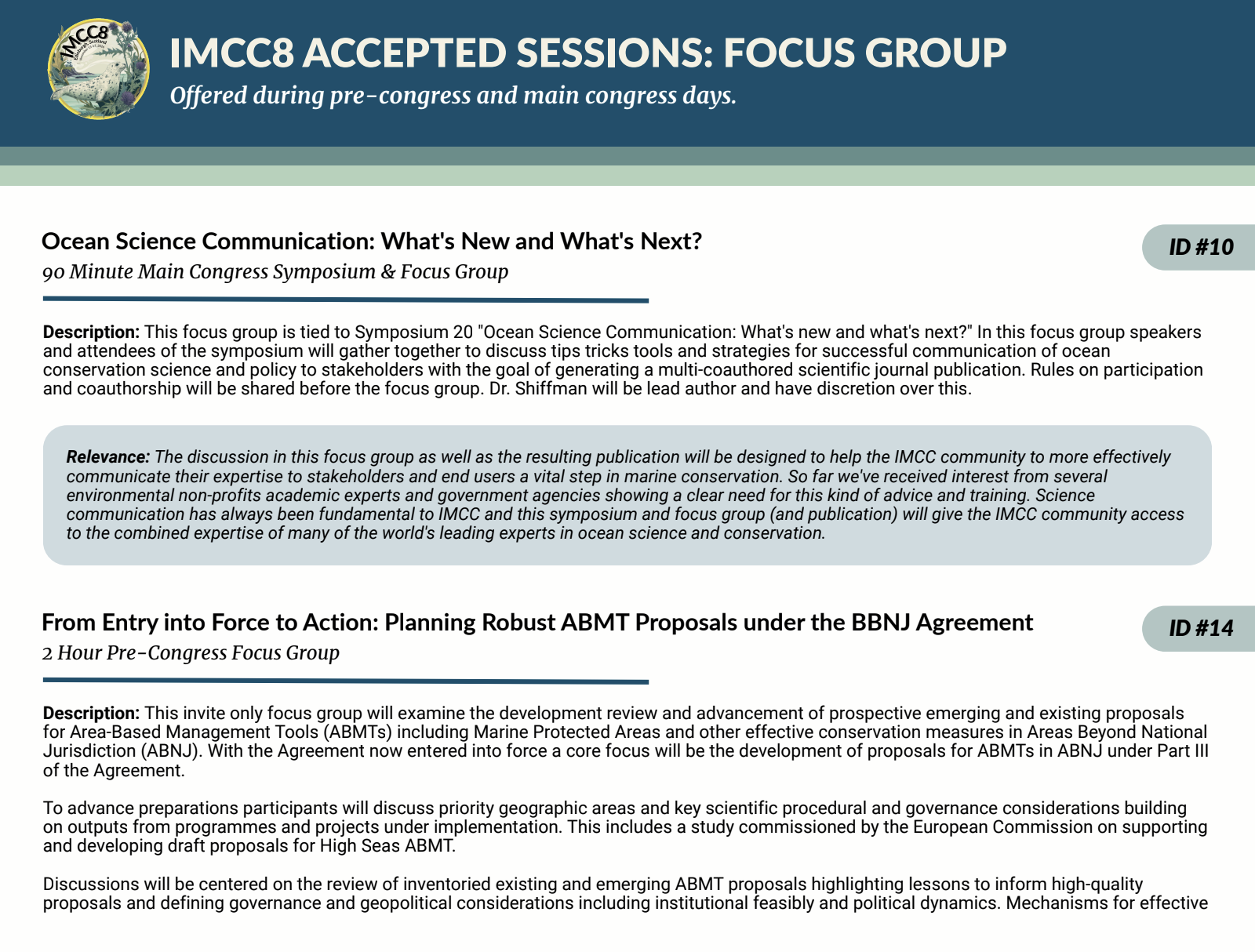
Ocean Science Communication: What's New and What's Next?: Participants will gather to discuss strategies, tools, and best practices for communicating ocean conservation science to stakeholders. The session aims to generate a multi-coauthored scientific journal publication led by Dr. Shiffman.
-
Planning Robust ABMT Proposals under the BBNJ Agreement: This invite-only group will examine the development and review of proposals for Area-Based Management Tools (ABMTs) in the high seas. Discussions will center on scientific, procedural, and governance considerations to support future submissions to the BBNJ COP.
-
How to Navigate to Marine Human Wildlife Coexistence: Interdisciplinary specialists will explore how to adapt terrestrial human-wildlife coexistence frameworks to marine systems, specifically identifying emerging drivers like offshore energy and climate change. The group plans to publish a peer-reviewed paper and establish a permanent marine coexistence network.
-
Exploring Best Practices for Marine Conservation and Vertical Zonation: This focus group examines the ecological defensibility and governance challenges of "vertical zoning," where protection levels vary by depth rather than covering the entire water column. It aims to guide high seas MPA design and inform national conservation planning tools.
-
Applying the Blue Park Standard and The MPA Guide to the High Seas: Experts will review and adapt existing effectiveness frameworks to ensure that future high seas MPAs established under the BBNJ Agreement deliver measurable biodiversity outcomes. The objective is to provide clear guidance for preparing strong, science-based conservation proposals.
-
Addressing Cross-Taxa Threats in the Ocean: Policy Pathways for Conservation: Members of the IUCN Species Survival Commission and other practitioners will examine interacting threats—such as pollution, trade, and climate change—that affect multiple species simultaneously. The group will identify integrated policy actions to inform the IUCN SSC Marine Conservation Committee’s policy plan.
-
Advancing Seamount Protection in Areas Beyond National Jurisdiction: Benthic and pelagic experts will develop a roadmap for implementing longstanding UN commitments to protect seamounts as vulnerable marine ecosystems. The session will produce a policy brief targeting governance gaps in regional fisheries management.
-
Co-developing Ocean Literacy for the UN Ocean Decade and Beyond: Participants will evaluate and refine the 20-year-old underlying principles of ocean literacy to ensure they are fit for modern conservation challenges. The session aims to identify pathways for meaningful impact and produce a peer-reviewed publication.
-
Building a North-East Atlantic Monitoring Community (BRUVS): This group aims to standardize protocols and establish a coordinated regional working group for using baited remote underwater video systems (BRUVS) to monitor marine health. The session will work toward a formal code of practice and a synthesis publication.
-
Human Dimensions of Large-Scale Marine Protected Areas: Building on symposium discussions, this group will produce a tangible policy brief that translates social science evidence from existing large-scale MPAs into considerations for high seas governance. It focuses on pillars such as equity, financing, and legitimacy in ABNJ contexts.
-
UK MPAs: Success Stories and Priorities for the Next Decade: Practitioners will review the current state of the UK's MPA network to identify future priorities regarding ecological metrics, governance coherency, and stakeholder involvement. The session will produce a report of recommendations to update a seminal 2020 review paper.
-
Advancing Marine Conservation Through Nature Bonds: Participants from global Nature Bonds projects will share lessons learned from implementing debt conversions for conservation and climate action. The session will result in a white paper compiling shared knowledge on sustainable conservation financing and governance. This focus group is by invitation only, with mire details to follow.
-
Building a More Inclusive Participatory and Action-Oriented Marine Conservation Community: This closing session synthesizes key themes from the Congress to identify institutional changes needed to advance inclusive and community-led conservation. It focuses on establishing priorities for the community to better connect knowledge with grounded action before the next meeting.
-
Novel Approaches to Advancing Small Pelagic Fisheries Science and Management: This interactive session explores practical steps for strengthening transboundary cooperation and improving baselines for data-poor fisheries. The goal is to outline priority science needs and collaborative initiatives for integrating Indigenous knowledge into management.
-
Release the Kraken in the Aquarium: Revisiting Questions to Advance Marine Conservation: This horizon-scanning exercise revisits 71 high-priority research questions identified 15 years ago to determine which have been answered and identify new "Kraken" (urgent but ignored) issues. The group aims to create a new roadmap for applied research and funding prioritization.
Workshops
-
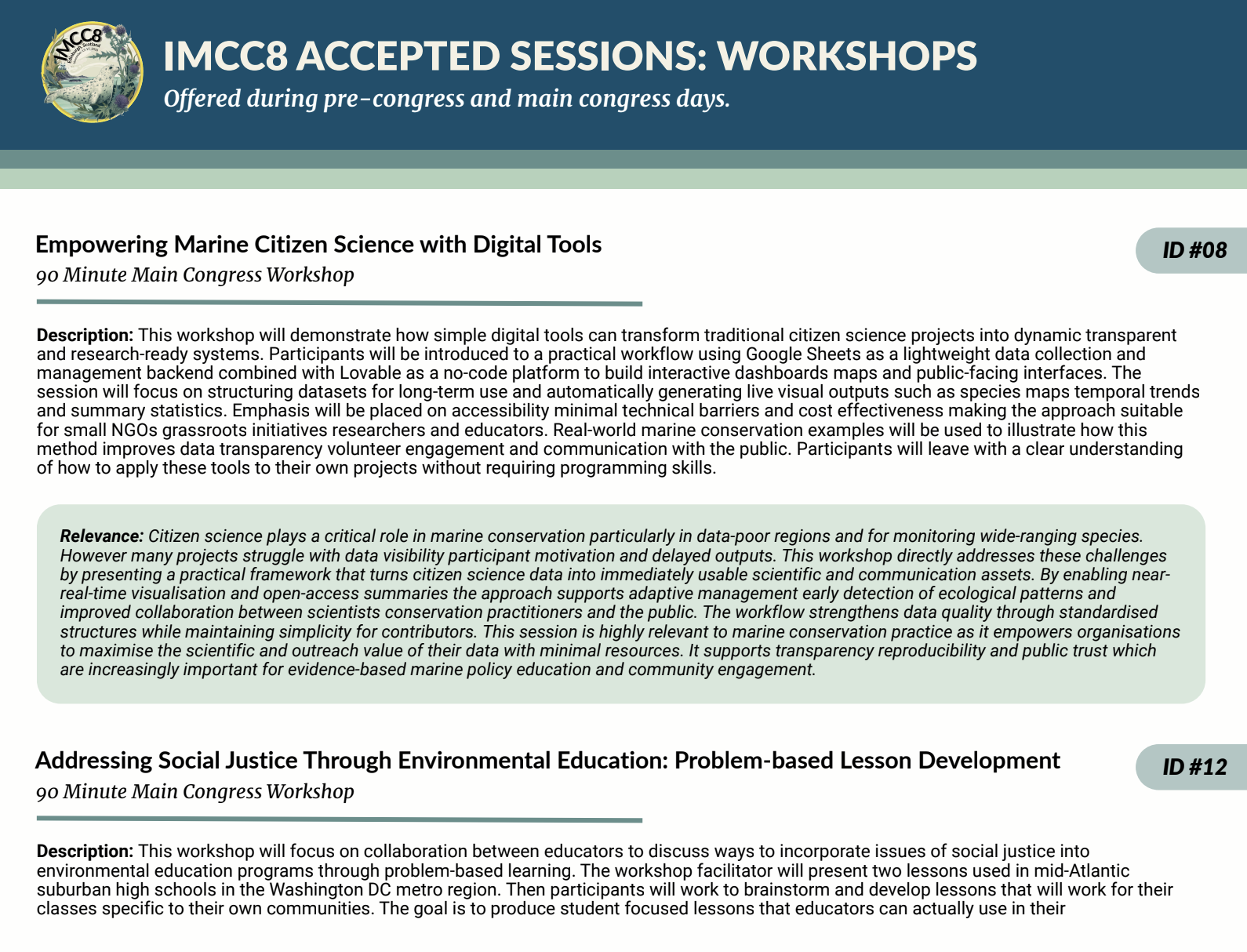
Addressing Social Justice Through Environmental Education: Problem-based Lesson Development: Educators will collaborate to develop student-focused, problem-based lessons that integrate social justice into environmental curricula. The goal is to provide students with tools for local stewardship and advocacy within their specific communities.
-
Applying the Conservation Standards to Build a Regional Conservation Program: Using a Dutch Caribbean case study, this workshop guides participants through the full planning process from defining targets like coral reefs to developing Theories of Change. It demonstrates how structured planning can align regional funding with measurable ecological outcomes.
-
Storytelling for Conservation: An Introduction to Building Impactful Conservation Stories: Participants will explore the biophysical science behind storytelling and use narrative basics—such as setting and conflict—to translate their scientific work into compelling stories. The session utilizes guided exercises to help conservationists make personal, sensory-driven connections with their audience.
-
Revealing the Human Footprint on the Oceans: Intro to Global Fishing Watch Data and Tools: This workshop introduces open-access datasets mapping human activity at sea, including vessel traffic and offshore infrastructure. Participants will create interactive workspaces to explore human impacts, such as fishing in no-take zones or bottom trawling, in their specific areas of interest.
-
Boats From Space! An Open Datajam to Monitor the High Seas: Small teams will analyze and visualize satellite-derived vessel data to investigate maritime activities in areas beyond national jurisdiction. The collaborative "datajam" aims to demonstrate how innovative, open tools can support the enforcement of high seas Marine Protected Areas.
-
The Ocean Highways Initiative: Integrating Multifaceted Data to Guide: Conservation Management Experts will work to advance a network-based global approach to conservation that accounts for animal movements, cultural heritage, and anthropogenic threats. The session aims to standardize criteria for the initiative and develop a roadmap for integrating global connectivity into the BBNJ framework.
-
Sailing Together: Designing Impactful Marine Education for Ocean Conservation: Participants will critically examine marine education initiatives to understand pedagogical methodologies and how to adapt them to various conservation contexts. The course includes hands-on exercises to design educational activities that promote critical thinking and long-term behavioral change.
-
How to Assess Expected Effectiveness of Marine OECMs for Biodiversity Conservation: This workshop introduces The Marine OECM Guide and its User Manual, a tool designed to evaluate the conservation value of "other effective area-based conservation measures". Attendees will discuss how to use this tool to recognize areas that meet effectiveness requirements while respecting human rights and local consent.
-
The Big Blue Puzzle: Putting UK Marine Management Pieces Together: Participants will use new mapping and analytics tools to overlay UK regulatory datasets with vessel activity and habitat layers. The session focuses on revealing where management is working and how post-Brexit fisheries frameworks offer new opportunities for co-managed reserves.
-
Data-informed Decision Making: Spatial Data Wrangling and Spatial Prioritisation: Attendees will gain hands-on experience in systematic conservation planning by cleaning spatial data and using R packages like prioritizr. The workshop provides the technical skills necessary to produce data-driven results that facilitate the development of protected areas to reach 30x30 targets.
-
Introduction to Photovoice: A Tool for Empowering Coastal Communities: This course introduces a participatory research method where community members use photography and storytelling to document their own social and ecological realities. Drawing on a case study from Peru, it demonstrates how to use visual narratives to reveal overlooked roles, such as those of women in small-scale fisheries.
-
Ocean Kraals as Living Heritage: A relational, story-led approach to Voices of the Sea: This is an exploration of South African ocean kraals, also known as fish traps, as a living framework of Indigenous coastal heritage and a place of gathering, nourishment, memory, and belonging that shape relationships between people and the sea. Attendees will be invited to engage in story listening, small group dialogue, sensory-engagement, and arts-based inquiry. The workshops will conclude with a reflection on how relational, heritage-led approaches might reshape marine conservation research, education, and practice.
-
Just One Joke: Crafting Levity in Marine Conservation: Guided by a marine scientist and comedian, participants will learn common joke structures and research on the effective use of humor in education and activism. Each attendee will craft and refine one joke related to their conservation focus to help break tension and maintain engagement in difficult talks.
-
Core Career Skills Development Workshops: These mini-sessions provide professional coaching on networking, resume/CV writing, interviewing, and negotiating offers for students and early-career professionals. The goal is to build confidence and help young professionals navigate the historically competitive field of marine conservation.
Art-led Sessions
-
Edinburgh Conservation Film Festival: Ocean Selection
-
This session features a curated screening of 6–10 short films exploring global marine issues, from dynamite fishing to ocean literacy. The films are followed by a panel discussion on the power of storytelling to drive conservation impact.
-
-
A Line in the Sound & Coastal Testimonies Exhibition
-
Participants will view a short film advocating for the protection of Scotland’s inshore waters from bottom-trawling, followed by a panel on marine restoration. The session concludes with a photographic exhibition reflecting the diverse perspectives of Scottish coastal communities.
-
-
Painting in the Abyss
-
This participatory session translates deep-sea science into a collective creative experience through live, large-scale painting. Attendees are invited to co-create an abyssal ecosystem on stage, fostering empathy and interdisciplinary dialogue regarding fragile seabed habitats.
-
-
Our Sea Forest
-
Through the screening of an award-winning BBC documentary, this session explores the emotional recovery of the Sussex kelp forests following a landmark trawling ban. A Q&A session will highlight how local community advocacy can inspire national environmental policy.
-
-
Through Her Lens: Women in Ancon’s Fisheries
-
This visual storytelling project highlights the often-overlooked roles and contributions of women within the fishing industry of Ancon. Through a series of photographs and narratives, the installation explores the intersections of gender, labor, and marine stewardship.
-
-
Inshore Fisheries: A Closer Look
-
Artist and policy officer Rosie Landon presents six oil paintings of iconic Scottish marine species to highlight the beauty and mismanagement of inshore fisheries. Accompanying text panels explain the specific conservation challenges and sustainable solutions required for each species.
-
-
Andania: The Sea’s Might
-
Filmmakers will share excerpts from a work-in-progress documentary and a photographic exhibition documenting the revival of ancestral Inca navigation traditions. The session explores how biocultural heritage and ancient maritime knowledge can strengthen modern climate resilience.
-
-
Mapping Ocean Memory: An Arts-Based Reflection
-
Participants are invited to write or sketch their earliest ocean memories onto cards using color and texture to capture sensory details. These cards are then added to a collaborative "Ocean Memory Wall," forming a growing collective landscape of personal connections to the sea.
-
-
The Sea We Share: A Collaborative Mosaic
-
Attendees contribute to a large-scale mosaic of a breaking wave by creating individual block-printed squares featuring marine motifs and one-word reflections. The final installation serves as a visual and multilingual portrait of the diverse community gathered at the conference.
-
-
Drawing the Ocean: Collective Comics for Hidden Marine Ecosystems
-
This workshop uses comic-strip storytelling to help participants reimagine and illustrate overlooked or "hidden" marine habitats, such as seagrass meadows. By creating illustrated interactions between species, attendees explore ecological threats through an inclusive, creative medium.
-